
Organisations invest significant time and resources into leadership development, employee engagement programmes and cultural transformation. However, one important question often remains: how do you know whether workplace behaviours are actually changing?
Introducing new processes, delivering training sessions or communicating company values does not automatically lead to meaningful change. The real measure of success is whether employees and leaders begin thinking, acting and working differently.
Measuring behavioural change in the workplace helps organisations understand whether their initiatives are making a genuine difference to employee engagement, team performance and overall business outcomes.
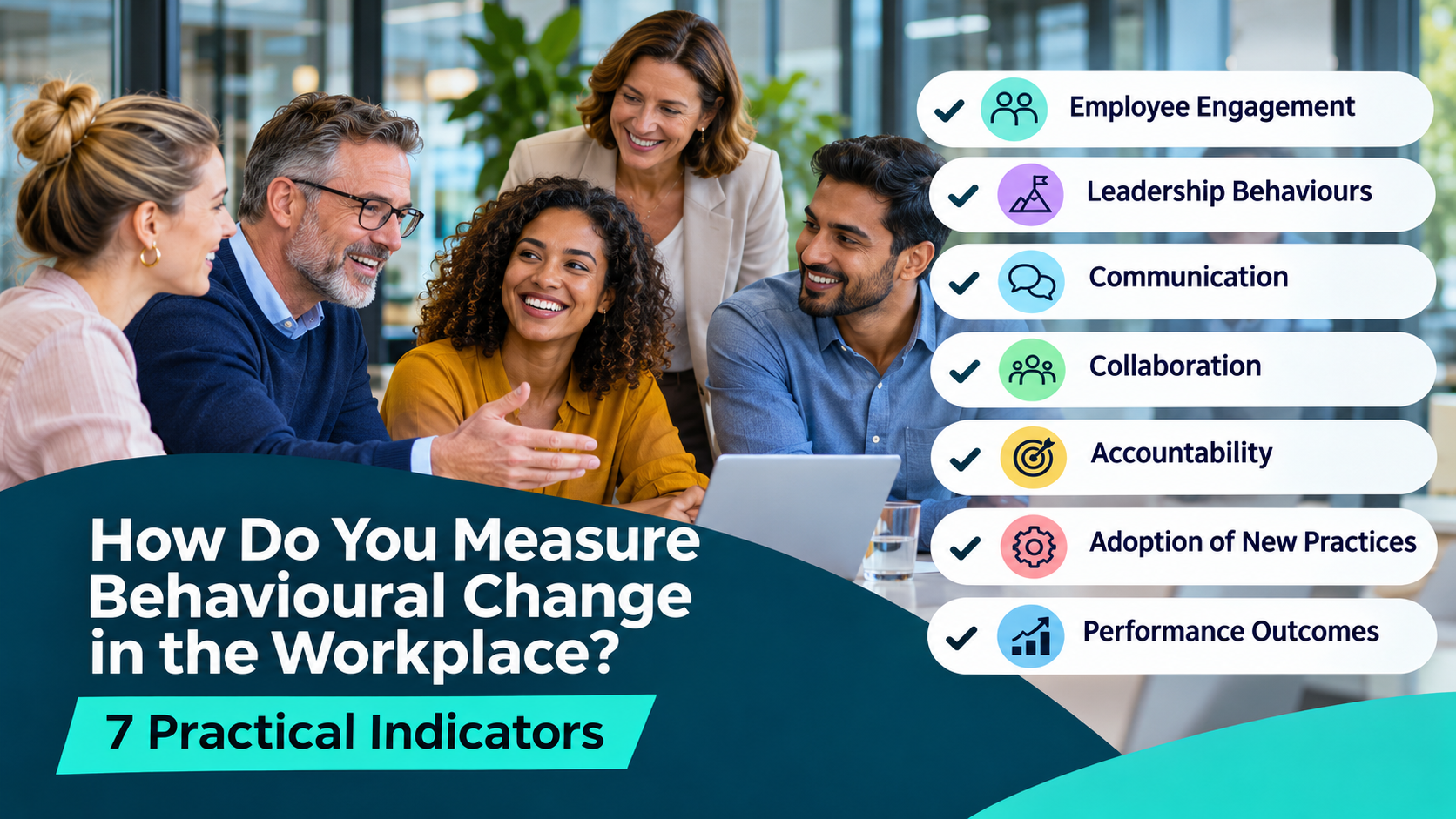
In this guide, we explore seven practical indicators that can help organisations track behavioural change and identify opportunities for continued improvement.
What Is Behavioural Change in the Workplace?
Behavioural change in the workplace refers to measurable improvements in how employees and leaders communicate, collaborate, make decisions and approach their responsibilities.
It involves replacing unhelpful habits or working practices with more positive behaviours that support organisational objectives.
For example, behavioural change might involve managers becoming more approachable, employees taking greater ownership of their responsibilities or departments working together more effectively.
Unlike changes to systems or policies, behavioural change focuses on people and their everyday actions.
Through effective behavioural change management, organisations can identify the behaviours that need to change, establish clear expectations and develop strategies to encourage lasting improvements.
Why Is Measuring Behavioural Change Important?
Without measurement, organisations risk confusing activity with progress.
A leadership workshop might receive excellent feedback, but does that mean managers are communicating more effectively? An employee engagement initiative might generate enthusiasm initially, but are employees genuinely more motivated six months later?
Measuring behavioural change allows organisations to:
-
Identify whether development initiatives are delivering meaningful improvements.
-
Understand how employees experience organisational culture.
-
Recognise successful leadership behaviours.
-
Identify barriers preventing positive change.
-
Connect behavioural improvements with business performance.
-
Make informed decisions about future development.
The key is to combine employee feedback with observable behaviours and measurable business outcomes.
7 Practical Indicators for Measuring Behavioural Change
1. Employee Engagement and Motivation
Employee engagement is one of the clearest indicators of workplace culture.
When employees feel valued, supported and connected to organisational objectives, they are more likely to contribute positively.
However, engagement should be measured consistently rather than relying on occasional annual surveys.
Practical measurement examples:
-
Conduct regular employee pulse surveys.
-
Track employee satisfaction and engagement scores.
-
Monitor voluntary staff turnover and absenteeism.
-
Measure participation in workplace improvement initiatives.
-
Ask employees whether they feel listened to and appreciated.
For example, if the percentage of employees who feel their opinions matter increases from 55% to 75%, this may indicate an improvement in engagement.
However, survey results should be supported by evidence of changing behaviours, such as greater participation in team discussions.
2. Leadership Behaviours and Management Effectiveness
Leadership plays a central role in shaping organisational culture.
Employees observe how leaders communicate, respond to challenges, make decisions and demonstrate company values.
Effective leadership development should therefore produce visible improvements in management behaviours.
Practical measurement examples:
-
Introduce 360-degree leadership feedback.
-
Assess the quality and frequency of one-to-one meetings.
-
Monitor how managers respond to employee concerns.
-
Evaluate delegation and decision-making practices.
-
Track improvements against individual leadership development goals.
For example, a manager who previously avoided difficult conversations might begin providing regular, constructive feedback.
Employee feedback and structured observations can help establish whether these improvements are sustained.
3. Communication Quality and Transparency
Poor communication can create uncertainty, misunderstandings and disengagement.
Successful behavioural change often becomes apparent when communication improves across different levels of an organisation.
Rather than simply measuring the number of emails or meetings, organisations should assess whether communication is clear, consistent and effective.
Practical measurement examples:
-
Survey employees about communication clarity.
-
Track misunderstandings and repeated requests for clarification.
-
Assess participation during team meetings.
-
Monitor how effectively organisational updates are understood.
-
Gather feedback on managers’ communication styles.
For example, if employees increasingly understand organisational priorities and feel comfortable asking questions, this suggests communication behaviours are improving.
Investing in leadership coaching can help managers develop stronger communication skills, encourage open conversations and build more trusting relationships with employees.
4. Collaboration and Teamwork
Collaboration is another important indicator of positive behavioural change.
Organisations often struggle with departments operating independently, competing priorities or limited knowledge sharing.
Improved collaboration should result in employees working towards shared objectives rather than focusing exclusively on individual responsibilities.
Practical measurement examples:
-
Track participation in cross-departmental projects.
-
Gather feedback on teamwork and cooperation.
-
Monitor how quickly teams resolve shared challenges.
-
Measure knowledge-sharing activities.
-
Review project outcomes involving multiple departments.
For example, if previously disconnected departments begin holding regular planning sessions and resolving issues collectively, this demonstrates meaningful behavioural improvement.
Professional team coaching can help organisations strengthen trust, improve collaboration and establish more productive working relationships.
5. Accountability and Ownership
A positive workplace culture encourages employees to take responsibility for their actions, commitments and results.
Accountability is not about assigning blame. It involves creating an environment where individuals understand expectations, take ownership and actively address challenges.
Practical measurement examples:
-
Monitor completion of agreed actions.
-
Track missed deadlines and repeated issues.
-
Assess whether employees proactively raise concerns.
-
Review ownership of tasks and responsibilities.
-
Gather feedback on reliability and follow-through.
For example, a team that previously relied on managers to resolve every problem might begin identifying solutions independently.
This shift towards greater ownership can indicate increased confidence, trust and accountability.
6. Adoption of New Working Practices
Organisations frequently introduce new technology, processes and ways of working.
However, successful implementation does not necessarily mean employees have adopted the intended behaviours.
Measuring adoption helps determine whether new practices have become part of everyday working life.
Practical measurement examples:
-
Monitor consistent use of new systems.
-
Assess compliance with updated working practices.
-
Track completion of relevant tasks using new processes.
-
Gather employee feedback on barriers to adoption.
-
Measure whether old, inefficient practices are declining.
For example, introducing a new project management platform is only successful if employees consistently use it to plan, communicate and manage responsibilities.
The objective is to measure genuine adoption rather than simply counting training attendance or system logins.
7. Performance and Business Outcomes
Ultimately, positive behavioural change should contribute to improved organisational performance.
While not every behavioural improvement immediately produces a financial return, organisations should identify connections between workplace behaviours and meaningful business results.
Practical measurement examples:
-
Monitor employee productivity.
-
Track customer satisfaction and complaints.
-
Measure employee retention.
-
Review project delivery times.
-
Assess quality, efficiency and operational performance.
For example, improved communication and collaboration might contribute to fewer project delays, better customer experiences and stronger productivity.
It is important to recognise that business outcomes are influenced by multiple factors. Performance improvements should therefore be considered alongside direct evidence of behavioural change rather than attributed to one initiative automatically.
7-Point Workplace Behavioural Change Checklist
To measure behavioural change effectively, organisations should regularly review the following indicators:
-
Employee engagement: Are employees becoming more motivated, involved and satisfied?
-
Leadership behaviours: Are managers demonstrating more effective leadership practices?
-
Communication: Is information being shared more clearly and consistently?
-
Collaboration: Are teams working together more effectively?
-
Accountability: Are employees taking greater ownership of responsibilities?
-
Working practices: Are new processes and behaviours being adopted consistently?
-
Performance outcomes: Are behavioural improvements contributing to measurable business results?
By reviewing these indicators regularly, organisations can identify positive trends, address challenges and ensure workplace development initiatives continue delivering value.
How Often Should You Measure Behavioural Change?
Behavioural change rarely happens overnight. It requires consistent reinforcement, leadership commitment and ongoing evaluation.
A practical approach involves establishing baseline measurements before introducing changes, followed by regular progress reviews.
Monthly pulse surveys, quarterly behavioural assessments and longer-term performance reviews can help organisations identify trends.
For example, an organisation introducing a leadership development programme might measure management behaviours before training, three months afterwards and again after six months.
This provides a clearer understanding of whether improvements are temporary or becoming embedded within the workplace culture.
How Engage for Impact Can Help
At Engage for Impact, we understand that meaningful organisational transformation starts with people.
Through tailored behavioural change management, leadership development, employee engagement and cultural transformation support, we help organisations identify the behaviours that influence performance and develop practical strategies for improvement.
Our approach focuses on understanding your organisation’s unique challenges, creating measurable objectives and embedding positive behaviours that deliver sustainable results.
For senior leaders looking to strengthen their impact, executive coaching can provide valuable support in developing self-awareness, improving decision-making and leading organisational change effectively.
Whether you want to improve leadership effectiveness, strengthen collaboration or create a more engaged workforce, measuring behavioural change is an essential step towards achieving lasting success.
Ready to understand what’s really happening within your organisation?
Contact Engage for Impact to explore how positive behavioural change can help your people and your organisation thrive.